Most writers do not ask about proofreading and copyediting because they are secretly obsessed with editorial terminology. Nobody wakes up thinking, “Today feels like a good day to understand the production-stage difference between copyediting and proofreading.” If someone does, I respect them deeply, but I also want them to drink water and maybe go outside for a few minutes.
Usually, writers ask this question because they are standing at a very real and slightly uncomfortable point in the writing process. The manuscript exists now. It is no longer just an idea, a messy document, a folder full of half-named drafts, or a dream living rent-free in the author’s head. The chapters are there. The characters have made choices. The argument has been built. The memoir has found some shape. The book may not feel perfect, but it has become something solid enough to hand to another person, and that is when the anxiety starts speaking.
The writer begins to wonder what kind of help the manuscript actually needs. Is it ready for proofreading? Does it need copyediting first? Is the prose clear enough? Are there too many grammar issues? Will a proofreader fix awkward sentences? Will a copyeditor change the author’s voice? Is the book secretly a disaster in a nice font? That last question is not an official editing category, but many writers have thought it at least once.
The confusion is understandable because proofreading and copyediting sound similar from the outside. Both involve careful reading. Both catch mistakes. Both are detail-focused. Both happen after the writer has already done a lot of work. Both can make a manuscript cleaner, stronger, and easier to read. But they are not the same service, and treating them as the same thing can lead to disappointment.
A writer may ask for proofreading when what they really need is a deeper sentence-level edit. They may say, “I just need someone to catch typos,” but when the manuscript is read closely, the real issues are unclear sentence structure, inconsistent tense, repeated phrasing, punctuation patterns, awkward transitions, or character details that shift across chapters. On the other side, a writer may ask for copyediting because it sounds safer and more professional, even though the manuscript has already been revised, edited, and formatted, and what it truly needs is one final check before publication.
Sometimes the manuscript is not ready for either service yet. That is not an insult. It simply means the problems are bigger than spelling, grammar, or punctuation. The structure may still be loose. The pacing may slow in the middle. A romance conflict may depend on a misunderstanding that could be solved in one honest conversation. A thriller may reveal its clue so often that the suspense quietly leaves the room, puts on a coat, and goes home. A memoir may have strong scenes but no clear emotional thread. A nonfiction book may contain good ideas, but the chapters may not build in the right order.
So the real question is not only, “What is the difference between proofreading and copyediting?” The better question is, “What stage is my manuscript actually in?”
That question matters because proofreading and copyediting are both useful, but they solve different problems. Copyediting works inside the writing while the sentences are still open to correction, smoothing, and consistency work. Proofreading checks the final version after the writing should already be settled. A copyedit helps make the manuscript clearer and more consistent. A proofread helps make the finished page cleaner before it reaches readers.

That is the formal explanation. But from an author’s point of view, the difference feels much more personal.
Copyediting is the stage where the editor is still allowed to work with the writing. Proofreading is the stage where the editor is checking that the final version has not left small mistakes behind.
The simple difference
The simplest way I can explain it is this: copyediting cleans the writing; proofreading checks the final version.
A copyedit looks at the manuscript while the sentences can still be adjusted. It checks grammar, punctuation, spelling, word choice, tense, clarity, consistency, style, usage, dialogue punctuation, capitalization, small continuity issues, unclear pronouns, repeated words, awkward transitions, and the kinds of sentence-level problems that make a reader pause without always knowing why. It is not usually a full rewrite, and it is not the same as developmental editing, but it does go deeper than a final typo check.
A proofread comes later. It is the last careful pass before a manuscript is published, printed, uploaded, submitted, or shared. It looks for typos, missing punctuation, repeated words, extra spaces, inconsistent headings, formatting slips, bad line breaks, page-number problems, incorrect running headers, table-of-contents mismatches, missing quotation marks, capitalization slips, and small errors that survived editing, revising, and formatting.
Both require skill. Both require patience. Both require the kind of attention that makes normal people ask, “How did you even notice that?” But they are not interchangeable. Copyediting asks whether the writing is clear, correct, and consistent. Proofreading asks whether this final version is clean.
A copyeditor may look at a sentence and notice that the grammar technically works, but the meaning is muddy. A proofreader may only correct the typo inside that sentence. A copyeditor may notice that a fantasy term is spelled three different ways across the manuscript. A proofreader may catch that one version is missing a capital letter. A copyeditor may query a timeline problem. A proofreader may catch the extra space after a period. Neither job is better than the other. They are built for different moments.
A practical comparison:
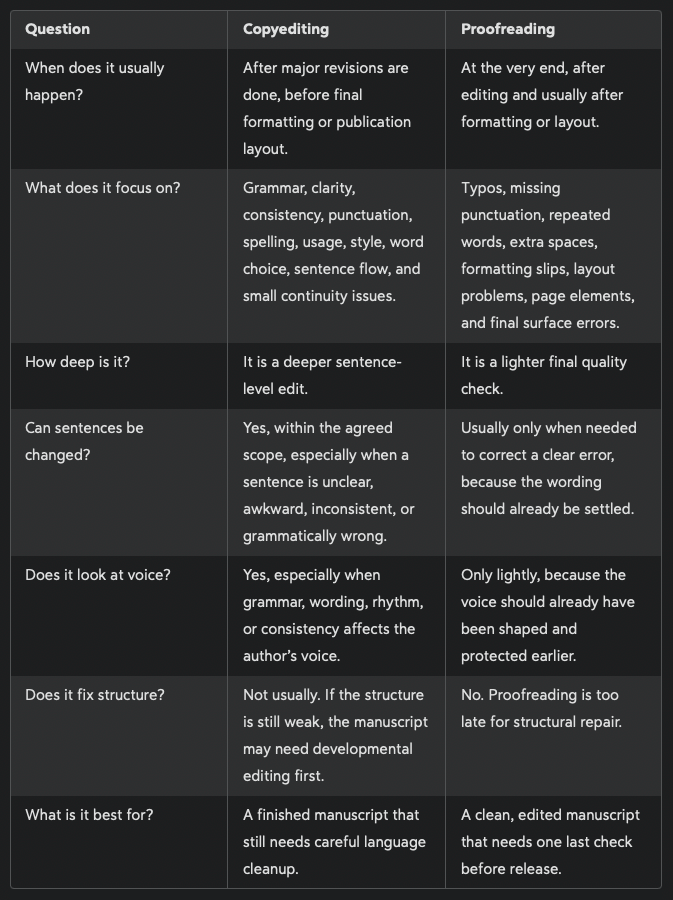
This table is useful, but it should not be treated like a law carved into stone by the gods of punctuation. Editing terms can vary slightly depending on the editor, publisher, country, genre, and project. Some editors include light line editing inside copyediting. Some separate line editing and copyediting very strictly. Some projects combine proofreading with light copyediting because of budget or time limits. That does happen, especially in freelance and self-publishing contexts, but it should be discussed clearly before work begins.
That is why an author should not only ask, “Do you copyedit?” The better question is, “What does your copyedit include?” The service name matters less than the scope. Scope is what tells the author what kind of attention the manuscript will actually receive.
Where proofreading and copyediting sit in the editing process?
A manuscript does not always move through a perfectly neat editing process, especially outside traditional publishing. Self-publishing authors, freelance clients, indie authors, academic writers, memoirists, and first-time novelists may all approach editing differently. Some writers revise heavily on their own before hiring anyone. Some need several rounds of feedback. Some hire a developmental editor first, then a line editor, then a copyeditor, then a proofreader. Some can only afford one stage and need the most useful option for where the manuscript is right now.
Still, in a general publishing workflow, the order often looks like this: developmental editing comes first, line editing or stylistic editing comes after the big-picture issues are settled, copyediting comes after that, formatting or typesetting comes near the end, and proofreading happens last.
That order exists for a reason. A developmental edit looks at the book as a whole. It asks whether the plot works, whether the structure holds, whether the stakes are clear, whether the pacing supports the reader’s attention, whether the memoir has a clear emotional spine, or whether the nonfiction argument builds in the right order. It is concerned with the bones of the manuscript.
A line edit moves closer to the page. It looks at rhythm, tone, sentence flow, paragraph movement, emotional tension, dialogue, voice, pacing within scenes, and the way the writing feels as the reader moves through it. A line edit may reshape sentences more actively than a copyedit because its concern is not only correctness but expression.
Copyediting comes after those larger and more stylistic questions are mostly settled. It still works closely with the sentences, but the focus is more technical and exact. A copyeditor checks grammar, punctuation, spelling, usage, consistency, small continuity details, clarity, style choices, and anything that makes the manuscript feel uneven or confusing at sentence level.
Proofreading comes after that. By the time a manuscript reaches proofreading, the author should not still be moving chapters around, rewriting scenes, changing the argument, renaming characters, or deciding whether the ending works. Proofreading is not built for that kind of work. It is built for the final version, where the text is already edited and the job is to catch whatever small mistakes remain.
This is why proofreading should not be used as a shortcut for copyediting. If the sentences still need real work, the manuscript is not ready for a final proofread. If the structure is still unstable, it is too early even for copyediting. Asking proofreading to fix a manuscript that needs copyediting is a little like cleaning the windows while the wall behind them is still cracked. The glass may shine. The crack is still there, being dramatic.
What copyediting actually does?
A copyedit is a close sentence-level edit, but it is not the same as rewriting the book. It is not there to take the author’s voice away, make every sentence sound formal, or flatten the writing until it feels like it was written by a committee with excellent grammar and no soul. Good copyediting is more careful than that.
A copyeditor pays attention to the manuscript in front of them. A young adult novel does not need to sound like an academic paper. A memoir should not have its rawness polished out until the honesty disappears. A fantasy manuscript may need invented terms preserved carefully, not corrected into ordinary language. A thriller may need short, sharp sentences in certain scenes because the pace depends on them. A romance scene may need emotional restraint in the dialogue because saying everything too directly can weaken the tension. A nonfiction book may need clarity and structure without losing the author’s natural way of explaining ideas.
Copyediting is not about making writing fancy. It is about making writing clear, consistent, and controlled enough that the reader can stay inside the work. A copyeditor looks for errors, but they also look for friction. Friction is the small resistance a reader feels when a sentence is confusing, a name changes spelling, a pronoun points to the wrong person, a paragraph repeats itself, or a timeline detail does not match what came earlier.
A copyeditor may correct grammar and punctuation, but they may also notice that a sentence technically makes sense and still does not read well. For example, a sentence like this may not be completely broken: “The room in which she had once believed she would be safe had now become the place where every single thought she had spent years avoiding seemed to return to her all at once.” The sentence is trying to carry fear, memory, and emotional weight, but it is overloaded. Depending on the voice and scope of the edit, it might become: “The room had once felt safe. Now it held every thought she had spent years trying not to touch.” That change is not only about grammar. It is about clarity, rhythm, and emotional focus.
This is where copyediting becomes delicate. The editor is not trying to sound clever. The editor is trying to hear what the sentence wanted to be before it got tangled.
What clarity means in practice?
People often say copyediting improves clarity, but clarity can sound vague if nobody explains what it actually means. In real manuscript work, clarity is not a decorative word. It means the reader can understand who is doing what, what is happening, why it matters, and how one thought connects to the next without having to stop and untangle the sentence by hand.
Clarity can mean fixing a sentence where the subject and action are too far apart. It can mean changing a pronoun because the reader cannot tell who “she” refers to. It can mean breaking one overloaded sentence into two. It can mean moving information into a better order so the reader learns things when they need them. It can mean cutting repeated explanation because the emotion already landed the first time. It can also mean querying a sentence because the editor understands the individual words but not the actual meaning.
Take a sentence like: “Nina told Sara that she should leave before the police arrived.” The author probably knows who should leave, but the reader may not. Does “she” mean Nina or Sara? A copyeditor may revise the sentence if the answer is clear from context, or they may leave a query if it is not. The fix might be, “Nina told Sara, ‘You should leave before the police arrive,’” or it might be, “Nina told Sara that she herself would leave before the police arrived.” The right version depends on the scene, but the issue is not a typo. The issue is meaning.
Another example: “After reading the letter from her mother, the room felt smaller.” The room did not read the letter. This is a dangling modifier, and while many readers might still understand the sentence, it creates a small grammatical wobble. A copyeditor might revise it to: “After Mara read the letter from her mother, the room felt smaller.” It is a small change, but the sentence becomes cleaner.
In nonfiction, clarity may involve making abstract language more direct. A sentence like “This chapter explores the impact of negative communicative patterns on relational outcomes” may be appropriate for a particular academic audience, but if the book is written for general readers, it may create distance. A clearer version might be: “This chapter looks at how the way we speak to each other can slowly damage a relationship.” That is not dumbing the idea down. It is making sure the idea reaches the reader it was meant for.
Good copyediting is full of these decisions. They are not always dramatic. They are often small, quiet, and almost invisible when done well. But they make the page easier to trust.
Copyediting and consistency: Consistency sounds boring until it is missing. A manuscript can have a strong plot, memorable characters, and a real voice, but if small choices keep changing, the reader feels it. They may not stop and say, “This manuscript needs a better style sheet.” Most readers are not tiny publishing robots walking around with clipboards. They will simply feel that something is off.
A copyeditor watches for that feeling before the reader has to experience it. They look for whether the manuscript uses “toward” or “towards,” whether it uses “okay,” “OK,” or “ok,” whether a character is called “Mariam” in chapter one and “Marium” in chapter twenty, whether a fantasy kingdom is “Northvale,” “North Vale,” or “the Northern Vale,” and whether chapter headings are capitalized in the same way throughout the book. They also watch for whether thoughts are italicized or blended into the narration, whether text messages are formatted consistently, whether the manuscript uses British English or American English, and whether numbers are handled in a stable way.
Some variation is natural. Not every difference is a mistake. A character may speak differently from the narrator. A formal document inside the story may use a different style from the surrounding prose. A memoir may shift rhythm when moving between memory and reflection. The point is not to force every page into sameness. The point is to make sure the manuscript feels intentional rather than accidental.
This is why copyeditors often create or follow a style sheet. A style sheet is a document that records the editorial decisions for a specific manuscript. It may track spellings, names, places, invented words, capitalization, punctuation choices, numbers, abbreviations, timeline notes, unusual terms, and anything else that needs to remain consistent. For a fantasy novel, the style sheet might track magical terms, royal titles, invented languages, kingdom names, species names, and whether certain words are capitalized. For a historical novel, it might track period-sensitive language, dates, titles, and words that feel too modern. For nonfiction, it might track headings, citations, source names, abbreviations, repeated terms, and preferred spellings.
The reader may never see the style sheet, but they feel the effect of it. The book feels steadier. The world feels more controlled. The argument feels more professional. The author’s choices feel chosen, not accidental.
What proofreading actually does?
Proofreading is the final check, and final does not mean easy. A good proofread takes serious focus because the proofreader is looking for small errors after the author, editor, formatter, and sometimes several other people have already looked at the manuscript. At that stage, the obvious mistakes may already be gone. What remains can be sneaky.
A proofreader may catch a missing quotation mark, a repeated word, an extra space, an inconsistent heading, a page number problem, an incorrect running header, a chapter title mismatch, a bad line break, a formatting slip, or a typo introduced during layout. Proofreading is also about catching new errors that appear late in the process. This happens more often than authors expect. A sentence gets changed during copyediting, and now there are two spaces between words. A paragraph is moved during formatting, and now the scene break is missing. A chapter title is updated in the manuscript but not in the table of contents. A running header still uses an old working title. A quote mark is accidentally deleted. A word is corrected in one place but not another.
A proofreader is looking for these things. They are not usually there to say, “This chapter should start later,” or “This character’s motivation is unclear,” or “The emotional turn in this scene needs more space.” Those are real editorial concerns, but they belong to earlier stages. By the proofreading stage, the manuscript should not be undergoing deep surgery. A proofread is more like checking the stitches after the surgery is done.
This does not make proofreading small or unimportant. The small things matter because they are often what readers notice once the book is out in the world. A missing period in a private draft is not a disaster. A missing period in the final uploaded version may still not be the end of civilization, but it can make the work feel less careful than it actually is. Proofreading protects the final reading experience from those avoidable distractions.
A simple example: copyediting vs proofreading
Let us take a sentence from a fictional thriller manuscript: “Daniel checked the envelope again, it was still empty, except for the photograph he had already burned in chapter twelve.”
A copyeditor would notice several things in that sentence. First, there is a comma splice because two independent clauses have been joined with a comma. Second, the sentence says the envelope is empty, but then says it contains a photograph. Third, there is a continuity issue. If Daniel burned the photograph in chapter twelve, why is it here now? Maybe it is a second copy. Maybe this is intentional. Maybe the author changed the plot and forgot to update this scene.
A copyedit might become: “Daniel checked the envelope again. It was empty, except for a second copy of the photograph he thought he had burned in chapter twelve.” The editor might also leave a query: “Earlier, Daniel burns the photograph. Is this meant to be a second copy, or should this detail be revised?”
That is copyediting. It fixes the sentence, improves clarity, and asks about a story-level inconsistency that appears inside the line.
A proofreader would not usually reshape the sentence that much. If the manuscript had already been edited and formatted, the proofreader might catch something like this: “Daniel checked the envelope again. It was empty, except for a second copy of the photograph he thought he had burned in chapter twelve..” The proofreader would remove the extra period. Both changes are useful, but they are not the same kind of work.
A fantasy example: when consistency becomes worldbuilding?
Fantasy manuscripts are a good example because they often contain invented words, places, systems, titles, languages, creatures, objects, and rules. This makes consistency more than a technical detail. It becomes part of the worldbuilding.
Imagine a manuscript uses “The Ashborne Court” in one chapter, “Ashborn Court” in another, “the ash-borne court” in a glossary entry, and “The Ash-Borne Court” in a character’s formal introduction. A proofreader may catch one obvious typo near the end, especially if the manuscript is already formatted and the inconsistency appears on the final page. A copyeditor should notice the larger pattern across the manuscript and ask which form is correct. Then they would apply that choice consistently.
This matters because fantasy readers pay attention to the world. They remember names. They notice rules. They are willing to learn the language of a fictional place, but they need that language to hold still long enough for them to trust it. If the names keep shifting by accident, the world starts to feel less solid.
No reader may send a formal complaint titled “Inconsistency in Fictional Royal Naming Systems, Page 284,” but they will feel the wobble. And in fiction, the wobble matters.
A memoir example: when correctness is not the only question?
Memoir needs a different kind of care because voice is often tied closely to memory, emotion, and lived experience. A memoir may have grammar issues, but the editor has to be careful not to polish the life out of the writing. Sometimes plain language is the point. Sometimes a sentence fragment carries grief better than a perfectly complete sentence. Sometimes the author’s rhythm is part of the honesty.
Take this example: “I did not cry when they told me. I only nodded. Like if I moved too much, the whole room would know before I did.”
A rigid edit might try to “fix” the fragment and make everything grammatically complete. But a careful copyeditor would pause. The fragment may be doing emotional work. It may sound like shock. A smoother version might be grammatically neater, but it could lose the breath of the original.
This is why copyediting is not just rules. It is judgment. The editor has to know when to correct, when to query, and when to leave the sentence alone.
A nonfiction example: when the idea is strong but the path is cloudy?
In nonfiction, copyediting often works at the level of explanation. The author may know the subject deeply, but the reader is meeting the idea for the first time. That difference matters. A sentence that feels obvious to the writer may feel dense to the reader because the writer has already done the thinking behind it.
For example, a paragraph may contain a strong argument, but each sentence may begin in a slightly different direction. One sentence defines a term, the next introduces a study, the next gives a personal example, and the next jumps to a conclusion without enough connection. A developmental editor might look at the order of the whole chapter, but a copyeditor may still help at the paragraph level by smoothing transitions, clarifying references, and making sure the logic moves from one sentence to the next.
A copyedit may not rebuild the whole book, but it can make the author’s thinking easier to follow. It can turn a paragraph from “all the information is technically here” into “the reader can actually move through this without needing a map, a torch, and emotional support.”
Why proofreading cannot fix a manuscript that needs copyediting?
This is one of the most important things for authors to understand. Proofreading cannot do the job of copyediting because proofreading comes too late and works too lightly. If the manuscript still has unclear sentences, inconsistent phrasing, grammar patterns, tense issues, awkward transitions, and repeated wording, a proofread may catch surface mistakes, but the deeper reading problems will remain.
The manuscript may become cleaner, but not clearer.
That difference can be frustrating. The author may pay for proofreading, the proofreader may do exactly what proofreading is supposed to do, and the manuscript may still not read the way the author hoped. That does not always mean the proofreader failed. It may simply mean the manuscript needed a different service.
A proofreader can correct “She walked passed the door” to “She walked past the door.” But a proofreader is not usually there to rebuild a sentence like this: “She walked past the door and felt everything from the last ten years rush back at her all at once in a way that made her feel like the whole house was breathing and she could not understand why she had come back here again when she knew that nothing good had ever happened in this place and probably never would.”
That sentence may need a line edit or copyedit, depending on the scope. It may need rhythm. It may need tightening. It may need the emotional focus brought forward. A proofreader can catch the typo inside it, but the sentence itself will still be carrying too much.
That is not a weakness of proofreading. It is simply not its job.
Why copyediting cannot fix a manuscript that needs developmental editing?
The opposite problem also happens. Sometimes a writer asks for copyediting because they know the manuscript needs help, but the problems are not really sentence-level problems. They are story, structure, pacing, argument, or character problems.
A copyeditor can fix grammar, smooth awkward wording, and keep the manuscript consistent. But if the middle of the novel has no momentum, copyediting will not create stakes. If the protagonist has no clear desire, copyediting will not build a character arc. If a memoir has powerful individual scenes but no clear emotional thread, copyediting cannot fully solve that. If a nonfiction book repeats the same argument in five different chapters, copyediting can make those chapters cleaner, but it cannot decide the best structure for the whole book unless the service includes developmental work.
This is why editing order matters. If the foundation is still moving, do not spend all your energy polishing the wallpaper.
A developmental edit may notice that the opening starts too early, the antagonist is more interesting than the protagonist, the romance conflict depends on a misunderstanding that feels too thin, the thriller reveals its clue too often, the memoir needs a clearer emotional spine, or the nonfiction book needs a stronger order of ideas. A copyedit may help once those bigger decisions are made, but it should not be expected to carry the whole weight of the manuscript.
What an editor notices during copyediting?
A copyeditor reads in a particular way. They are not reading only for enjoyment, but they are also not reading like a machine. They are reading for the places where the language gets between the author and the reader.
Some issues are obvious: spelling errors, missing commas, incorrect punctuation, repeated words, grammar mistakes, inconsistent capitalization, and tense slips. Other issues are quieter. A copyeditor may notice that the manuscript uses the same sentence shape too often: “She opened the door. She looked inside. She saw the letter. She picked it up. She read the first line.” That rhythm may work in a tense moment if it is intentional, but if the whole chapter moves like that, the prose may begin to feel flat.
A copyeditor may notice that a historical novel uses a phrase that feels too modern for the period. Not every historical novel needs stiff old-fashioned language, but one sharply modern phrase can pull the reader out of the scene. A copyeditor may notice that a young adult narrator explains every feeling twice: “I was embarrassed, and my face burned with embarrassment because I had never felt so embarrassed in front of him before.” The emotion is clear, but the repetition weakens it. The edit may tighten the line so the feeling lands once.
A copyeditor may also notice repeated physical actions. One character swallows. Another looks away. Someone exhales. Someone releases a breath. Someone stares at the floor. None of these actions are wrong by themselves, but across a full manuscript, repeated habits become visible. They start to flatten scenes and make different emotional moments feel strangely similar.
This is one reason a full-manuscript edit is different from fixing a few sample pages. On one page, a habit may look harmless. Across 80,000 words, it becomes very noticeable. The manuscript always tells on itself eventually, which is rude but helpful.
What an editor notices during proofreading?
A proofreader’s attention is different because the manuscript is already supposed to be settled. By this stage, the proofreader is not asking whether the chapter should exist or whether the dialogue could be more layered. They are looking for the errors that remain after the book has already been worked on.
They may notice that chapter headings are formatted differently, such as “Chapter Five,” then “CHAPTER SIX,” then “Chapter 7.” They may notice that the table of contents says “Chapter Twelve: The Return,” but the actual chapter title says “Chapter Twelve: Return.” They may notice a missing period at the end of a paragraph, a quotation mark that opens but never closes, an italic word that lost its formatting during layout, or a section break that disappeared and made two scenes run into each other.
They may notice that a character’s name appears correctly throughout the book but is misspelled once in the acknowledgements. They may notice that the running header still contains the book’s old working title. They may notice that a page number is missing, a heading is stranded awkwardly at the bottom of a page, or a link in an ebook file does not go where it should.
This is the kind of work that sounds small until it is your book and your reader finds the mistake. A proofread does not make the book magically perfect. No honest editor should promise that. But it does reduce the chance of distracting final errors making it into the version readers will see.
The author’s fear: “Will copyediting change my voice?”
This is a real fear, and editors should take it seriously. A manuscript is not just a file. It is months or years of thought, doubt, revision, attachment, frustration, hope, and private effort. When a writer hands it to an editor, there is often a quiet worry underneath the practical questions. Will the editor understand what I was trying to do? Will they make it sound like them instead of me? Will they flatten the parts that are supposed to feel raw? Will they judge the draft instead of helping it?
A good copyedit should not erase the author’s voice. It should protect it from the things that distract from it. If a narrator is blunt, the edit should not make them flowery. If the prose is intentionally spare, the editor should not decorate it. If a memoir uses plain language because the honesty depends on that plainness, the editor should not turn it into a formal essay. If a character speaks in fragments because they are frightened, guarded, or overwhelmed, the editor should not automatically “fix” every fragment into a complete sentence.
Correctness matters, but so does context. A sentence fragment in an academic paper may be an error. A sentence fragment in a grief-heavy scene may be voice. That is why copyediting requires judgment. It is not just rules. It is knowing when a rule supports the writing and when applying it too rigidly would damage the effect.
The other author fear: “Is my manuscript too messy?”
A lot of writers worry about this before sending work to an editor. The honest answer is that manuscripts arrive in different states. Some are very clean. Some are promising but uneven. Some have strong voices but messy punctuation. Some have good stories hiding under overwritten prose. Some have beautiful sentences but weak structure. Some have clearly been revised many times, but the author is now too close to see what is still confusing.
That does not make the writer unserious. It means they are in the middle of the process.
However, the state of the manuscript does affect what kind of editing it needs. If the manuscript is still messy at the level of plot, structure, pacing, argument, or character motivation, proofreading will not help enough. Copyediting may help the sentences, but it may not be the best first step. A manuscript evaluation, developmental edit, or beta read may be more useful before spending money on sentence-level cleanup.
If the manuscript is structurally solid but the writing is uneven, copyediting may be the right step. If the manuscript has already been edited, revised, and formatted, proofreading may be enough. The point is not to shame the draft. The point is to meet it honestly.
When a manuscript probably needs copyediting?
A manuscript probably needs copyediting when the story, argument, or content is mostly finished, but the language still needs careful cleanup. This usually means the author is no longer planning major rewrites, the chapters are mostly in the right order, the structure feels settled, and the main concern is now grammar, punctuation, clarity, consistency, spelling, style, and sentence-level readability.
A fantasy manuscript may not need anyone to rebuild the magic system, but it may need consistency in names, invented terms, capitalization, and dialogue punctuation. A romance manuscript may have a clear emotional arc, but the prose may need tightening so the tension does not get buried under repeated internal thoughts. A thriller may have a good plot, but the copyedit may catch places where clues are explained too heavily or repeated in a way that weakens suspense. A memoir may have a strong voice, but the grammar and sentence flow may need care so the emotion comes through without confusion. A nonfiction manuscript may have useful ideas, but the copyedit may need to smooth transitions, check repeated terms, clarify pronouns, and make sure the style is consistent from chapter to chapter.
Copyediting is especially useful when the manuscript is already strong enough that the editor does not need to keep asking, “Should this chapter exist?” Instead, the editor can focus on how the writing is working line by line and page by page. It is not there to make the manuscript sound fancy. It is there to make the writing clean, clear, and steady enough for the reader.
When a manuscript probably needs proofreading?
A manuscript probably needs proofreading when it has already been revised, edited, and prepared for its final form. This usually means the author has finished major revisions, the language feels settled, the manuscript has already had the editorial attention it needs, and the book is now close to publication, upload, print, submission, or sharing.
Proofreading is for the moment when the author is almost done. Not “I hope this edit will fix everything,” but “This has already been worked on, and I want one careful final pass before it leaves my hands.” That is the right time for proofreading.
A proofread may catch the missing comma in a dedication, the inconsistent spelling in a character list, the extra space in a chapter heading, the repeated word in the final paragraph, the typo that appeared after formatting, or the table-of-contents mismatch that nobody noticed because everyone had already stared at the manuscript for too long. It is not dramatic work. It is quiet work. But quiet does not mean unimportant.
When the manuscript may need something deeper than both?
Sometimes the most honest answer is that neither proofreading nor copyediting should be the first step. If the author is still asking whether the plot works, whether the ending is earned, whether the middle drags, whether the opening starts in the right place, whether readers will understand the world, or whether the book’s argument makes sense, the manuscript may need developmental editing, a manuscript evaluation, or beta reading before copyediting or proofreading.
A developmental editor looks at the manuscript as a whole. They may help with plot structure, pacing, character arcs, stakes, point of view, chapter order, scene purpose, nonfiction argument flow, memoir structure, genre expectations, reader confusion, missing material, or repeated material. A beta reader may respond more like a test reader, explaining where they felt engaged, confused, bored, surprised, or emotionally invested. A manuscript evaluation may give the author a broad editorial letter without editing the manuscript line by line.
These services are not replacements for copyediting or proofreading. They are earlier stages. If the book needs structural work, that should usually happen first. If the sentences need cleaning after that, copyediting comes next. If the final version needs one last check, proofreading comes last. That order saves time, money, and frustration, and manuscripts already create enough frustration on their own without us adding extra seasoning.
What happens if the author chooses the wrong service?
Choosing the wrong service does not mean everything is ruined, but it can lead to disappointment. If an author chooses proofreading when the manuscript needs copyediting, the proofreader may catch typos and obvious errors, but the writing may still feel rough. The sentences may still be awkward. The consistency problems may still be there. The reader may still have to pause and reread.
If an author chooses copyediting when the manuscript needs developmental editing, they may end up polishing pages that later need to be cut or heavily rewritten. That can feel productive in the moment because the manuscript looks cleaner, but it may not be the best use of money or effort. It is painful to polish a chapter beautifully and then realize the chapter does not belong in the book.
If an author chooses a heavy copyedit when the manuscript only needs proofreading, they may receive more changes than necessary. At the final stage, too much tinkering can sometimes create new problems, especially if the book has already been formatted. A small wording change can affect a line break. A line break can affect a page. A page change can affect a table of contents or index. Books are dramatic like that.
The right edit should match the stage of the manuscript. It should not be chosen out of panic, pride, or the fear that the most expensive service must automatically be the best one. The best editorial choice is not always the biggest service. It is the right service for where the book actually is.
A realistic note about “perfect” manuscripts
No serious editor should promise that a manuscript will become perfect. Editing reduces problems. It improves clarity. It catches mistakes. It makes the work more consistent. It helps the reader move through the writing with fewer distractions. But no human process can honestly guarantee that every single typo will be caught, every reader will respond well, every agent will be interested, or every review will be positive.
That is not how books work.
Even traditionally published books can contain small errors. They pass through many hands, and sometimes a change made late in the process introduces something new. This is one reason proofreading exists as a final check after copyediting and formatting. The goal is not magical perfection. The goal is a manuscript that is cleaner, clearer, more consistent, and more ready for the reader than it was before.
That is honest editing.
How to decide what your manuscript needs?
The simplest way to decide is to look at the kind of questions you are still asking about the manuscript. If you are asking whether the story works, whether the structure is strong, whether the stakes are clear, whether the middle drags, whether the character arc is believable, or whether the nonfiction argument is in the right order, then the manuscript is probably still in developmental editing territory.
If you are asking whether the writing feels smooth, whether the voice is strong, whether the dialogue sounds natural, whether the sentences are too stiff or too wordy, whether the emotion lands, or whether the pacing works at paragraph and scene level, then the manuscript may need line editing or a heavier sentence-level edit.
If you are asking whether the grammar is clean, whether the sentences are clear, whether the style is consistent, whether names and terms are handled the same way throughout, whether punctuation and capitalization are stable, and whether there are small contradictions or confusing details, then the manuscript probably needs copyediting.
If you are asking whether the final version has typos left, whether formatting introduced mistakes, whether headings and page numbers are consistent, whether spacing and punctuation are clean, and whether the manuscript is ready for publication, upload, printing, or submission, then the manuscript probably needs proofreading.
These questions are not perfect, but they help. If the author is still unsure, a sample edit or manuscript assessment can be useful because a small sample often reveals what level of editing the manuscript actually needs. Sometimes the sample shows that the manuscript is cleaner than the author feared. Sometimes it shows that proofreading would not be enough. Either way, it gives both the author and the editor a more honest starting point.
A few honest myths about proofreading and copyediting?
One common myth is that proofreading is just cheaper copyediting. It is not. Proofreading may cost less in some cases because it is usually lighter and later, but that does not mean it is a budget version of copyediting. It has a different purpose. Asking a proofreader to fix a manuscript that needs copyediting is like asking someone to check the paint while the wall is still cracked.
Another myth is that copyediting is just grammar. Copyediting includes grammar, but it is not only grammar. It also deals with clarity, consistency, punctuation, usage, spelling, style, small continuity issues, and author queries. In some projects, it may include light line editing, depending on what the editor and author agreed. The agreement matters because different editors use the terms slightly differently.
A third myth is that a proofread will catch everything. A proofread should catch many things, especially visible final errors, but no ethical editor should promise a completely error-free book. The more polished the manuscript is before proofreading, the stronger the proofread can be.
Another myth is that editing software can replace copyediting. Software can help catch some spelling, grammar, punctuation, and consistency issues, but it cannot fully understand voice, genre, emotional rhythm, intentional fragments, timeline logic, character consistency, reader expectation, or whether a sentence is technically correct but still confusing. Tools can assist. They cannot fully replace editorial judgment.
The last myth is that copyediting will ruin the author’s voice. Bad editing can damage voice. Good editing should not. A careful copyeditor should understand when to correct, when to query, when to leave something alone, and when the “mistake” is actually part of the style.
The difference in real terms:
Proofreading and copyediting are close enough that people confuse them, but different enough that the choice matters. Copyediting is deeper. It works while the manuscript can still be adjusted at sentence level. It looks at grammar, clarity, consistency, style, punctuation, usage, spelling, and small details that affect how the reader understands the work. Proofreading is later. It checks the final version for visible mistakes before the work goes out. It looks for typos, spacing problems, punctuation slips, formatting errors, layout issues, and small inconsistencies that remain after editing.
Copyediting is the careful cleanup of the writing. Proofreading is the last check of the finished page.
A manuscript that needs copyediting should not be rushed into proofreading. A manuscript that needs developmental work should not be rushed into copyediting. A manuscript that is already clean should not be over-edited just because the author is nervous. The best editorial choice is not the biggest service. It is the right service for the stage of the book.
That is what I would want an author to understand before hiring anyone. Not because terminology is important for its own sake, but because a manuscript is personal. It takes a lot to show someone your work. It takes trust to let another person into the sentences. The least an editor can do is be honest about what the manuscript needs, what the service can actually fix, and what should wait for another stage.
Proofreading and copyediting both care for the manuscript. They just care for it at different moments. A copyedit helps the writing become clearer and more consistent while there is still room to work. A proofread protects the final version from small errors that could distract the reader.